EN
 HR
 RU
 DE
When selecting a hydraulic hose, pressure is one of the most important technical specifications. However, technical documentation and manufacturers' catalogues may specify different pressure values – working pressure, test pressure and burst pressure.
Although all three values are expressed in units of pressure, their meanings and purposes differ significantly. Misinterpreting these specifications can lead to selecting an unsuitable hose, reducing the service life of the assembly, causing leaks or even resulting in serious hydraulic system failure.
In this article, we explain the differences between hydraulic hose working pressure, test pressure and burst pressure, what the safety factor represents, and why hose selection should never be based on a single pressure value.
What Do Hydraulic Hose Pressure Ratings Actually Mean?
During operation, a hydraulic hose must withstand the pressure of the fluid flowing through the system. However, pressure in an actual hydraulic system is not always constant.
During operation, the following conditions may occur:w
- working pressure fluctuations
- short-term pressure peaks
- pressure impulse loads
- vibrations and mechanical loads
- temperature fluctuations
Therefore, a hydraulic hose should not be selected solely based on the pressure reached by the system during normal operation.
Manufacturers and applicable standards define different pressure ratings to clearly distinguish between normal operating conditions, testing conditions and the ultimate limits of the hose's mechanical resistance.
The three terms that are particularly important to distinguish are working pressure, test/proof pressure and burst pressure.
What Is Hydraulic Hose Working Pressure?
Working pressure is the maximum pressure at which a particular hydraulic hose is designed to operate under specified conditions.
In technical documentation, it is often referred to as Maximum Working Pressure or WP (Working Pressure).
This is the primary value to consider when selecting a hose for a particular hydraulic system.
For example, if a system operates at 250 bar, it is not enough to check whether the hose can physically withstand 250 bar. The selected hose must have a maximum working pressure suitable for the system requirements and operating conditions.
It is also important to consider that:
- system pressure is not always constant
- pressure peaks may occur
- temperature may affect the permissible operating conditions
- dynamic loads affect the service life of the hose
Therefore, hose selection must always follow the manufacturer's technical specifications and the requirements of applicable standards.
What Is Test Pressure?
Test pressure is the pressure to which a hose or a completed hose assembly is subjected under controlled conditions during testing to verify its integrity.
In technical documentation, the terms Test Pressure or Proof Pressure may be used.
It is important to understand that test pressure is not the pressure at which the hose is designed to operate continuously.
During pressure testing, the following aspects are checked, among others:
- leak-tightness of the assembly
- integrity of the connections
- behaviour of the assembly at the specified test pressure
- presence of visible signs of defects or damage
The exact test pressure and testing procedure depend on the hose type, applicable standard, manufacturer's specifications and project requirements.
Therefore, a single universal test pressure value cannot be applied to all hydraulic hose assemblies.
What Is Hydraulic Hose Burst Pressure?
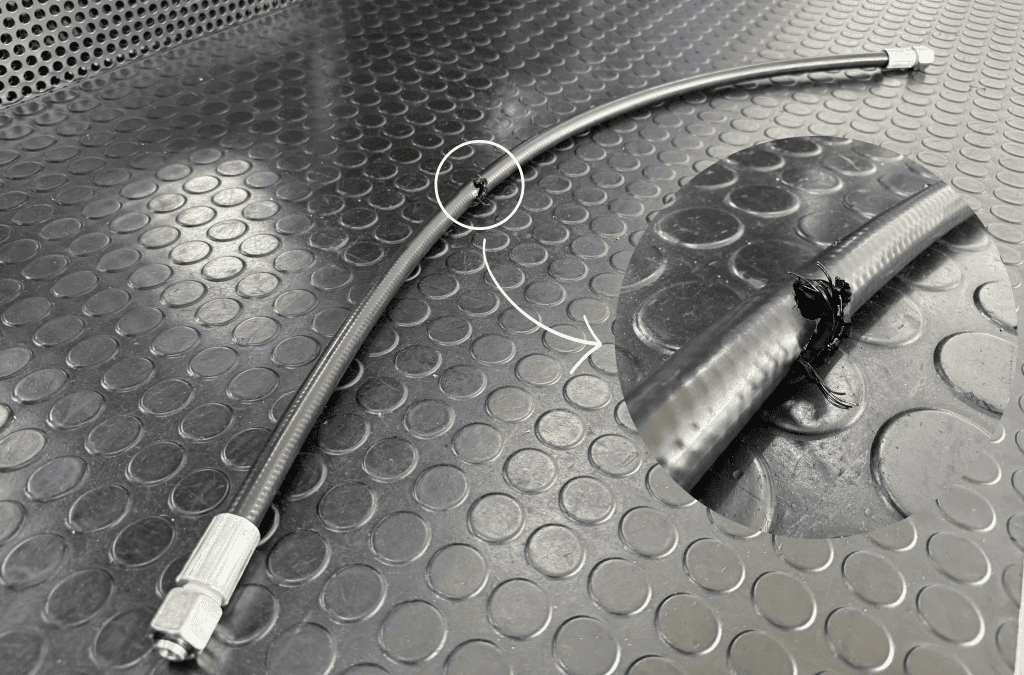
Burst pressure is the pressure at which a hose or hose assembly loses its structural integrity during destructive testing.
In technical documentation, it is referred to as Burst Pressure.
Unlike proof pressure testing, burst pressure testing is carried out until the tested product fails. Its purpose is not to confirm that the hose can operate at this pressure, but to determine its ultimate pressure resistance and verify the required ratio relative to the maximum working pressure.
Therefore, burst pressure must never be interpreted as the permissible working pressure of a hose.
For example, if a particular hose has a specified working pressure of 250 bar and a minimum burst pressure of 1000 bar, this does not mean that the hose can be operated at 500, 700 or 900 bar.
The relevant value for its application is the maximum permissible working pressure – 250 bar in this example.
Safety Factor – What Does a 4:1 Ratio Mean?
Many hydraulic hoses have a 4:1 safety factor between the minimum burst pressure and the maximum working pressure.
In simple terms, if a hose has:
- maximum working pressure: 250 bar
- safety factor: 4:1
the minimum burst pressure according to this ratio would be 1000 bar.
However, it is important to emphasise that the 4:1 ratio must not automatically be applied to every hose and application. The required safety factor depends on the hose construction, applicable standard, manufacturer and intended application.
The safety factor is also not an additional margin that the user may utilise to increase the operating pressure.
If the maximum working pressure of a hose is 250 bar, this is the limit that must be considered when designing and operating the system, regardless of the significantly higher burst pressure.
Why Is Burst Pressure Not the Permissible Working Pressure?
One of the potentially most dangerous mistakes is assuming that a hose can safely operate at pressures between its rated working pressure and burst pressure.
Burst pressure represents the ultimate limit determined through destructive testing, not normal operating conditions.
During its service life, a hydraulic hose may be subjected to numerous pressure cycles. Therefore, the ability of a hose to withstand a very high pressure once is not equivalent to its ability to operate safely under such loads over an extended period.
Exceeding the permissible working pressure can lead to:
- accelerated material fatigue
- damage to the reinforcement layers
- leakage
- fitting separation
- sudden hose assembly failure
Such a failure can cause machine downtime, damage to other equipment, hydraulic fluid loss and serious safety hazards.
The Impact of Pressure Impulses and Pressure Peaks
The nominal operating pressure of a system does not always provide a complete picture of the actual loads to which a hydraulic hose is exposed.
Sudden valve closure, changes in actuator movement direction or other rapid changes within the system can generate short-term pressure peaks.
Although these loads may last only a very short time, they can occur repeatedly throughout the machine's service life.
Therefore, in dynamic hydraulic systems, it is important to consider pressure impulse loads, not just the nominal working pressure.
A hose that has not been properly selected for such conditions may gradually deteriorate and fail, even if the average system pressure appears to remain within the permissible limit.
Why Are Finished Hydraulic Hose Assemblies Pressure Tested?
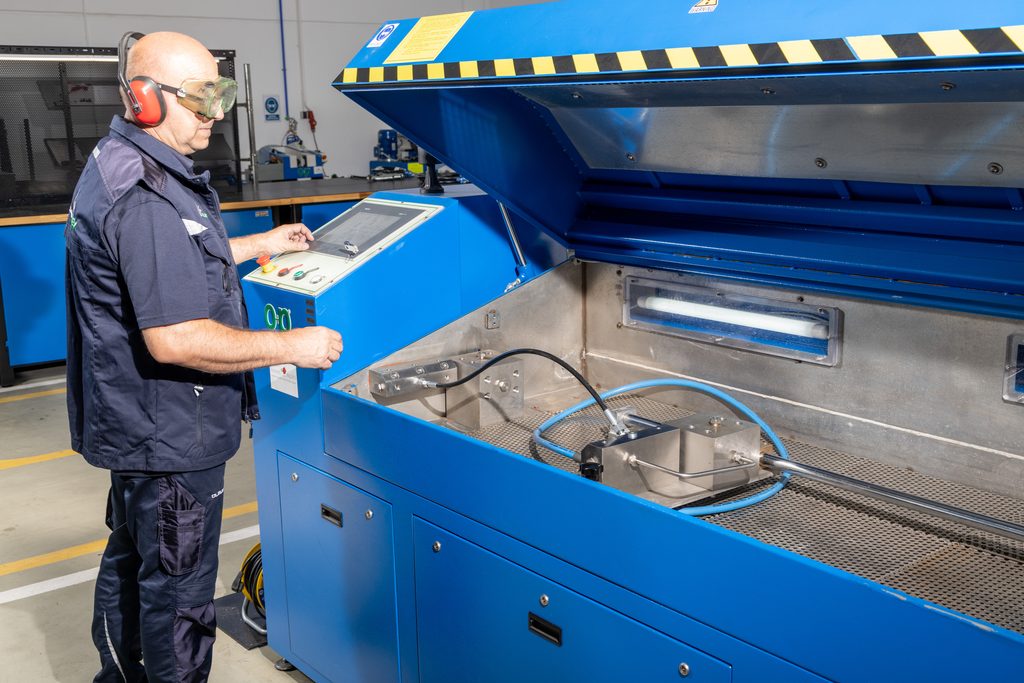
A hydraulic hose is only one component of a finished assembly. Its reliability also depends on the correct selection of fittings, the assembly method and the quality of crimping.
Therefore, in more demanding applications, finished hydraulic hose assemblies may undergo pressure testing before delivery or commissioning.
Pressure testing can help verify:
- leak-tightness
- integrity of the connections
- quality of hose assembly
- behaviour of the assembly at the specified test pressure
This is particularly important in applications where hose assembly failure could result in significant downtime, property damage or safety hazards.
OLEUM FLEX has equipment capable of hydrostatic pressure testing hose assemblies with water at pressures up to 2000 bar. Testing parameters are determined according to product specifications, applicable standards and project requirements.
Common Mistakes When Interpreting Pressure RatingsConfusing Working Pressure with Test Pressure
In practice, certain mistakes can significantly affect the safety and service life of a hydraulic system.
Confusing Working Pressure with Test Pressure
The fact that an assembly has successfully passed a pressure test at a pressure higher than its working pressure does not mean that it is designed to operate continuously at that pressure.
Using Burst Pressure as the Operating Limit
Burst pressure is not the permissible working pressure, nor does it represent an available safety margin for increasing system pressure.
Ignoring Pressure Peaks
Short-term pressure spikes can place significant stress on a hose, even when the nominal system pressure remains within permissible limits.
Considering Only the Hose Instead of the Entire Assembly
The operating characteristics of a finished assembly depend on all its components. The hose, fittings and assembly method must be mutually compatible and meet the requirements of the intended application.
Ignoring Other Operating Conditions
Pressure is not the only criterion. Temperature, operating fluid, bend radius, vibrations, external mechanical loads and installation conditions also influence proper hose selection.
Conclusion
Working pressure, test pressure and burst pressure are three distinct specifications that serve different purposes.
Working pressure defines the maximum pressure at which the hose is designed to operate under normal conditions.
Test pressure is used for controlled testing of a hose or finished hose assembly according to specified requirements.
Burst pressure represents the ultimate pressure resistance determined through destructive testing and must not be used as a criterion for determining the permissible working pressure.
Properly understanding these values is essential for safe hydraulic hose selection, but pressure should never be considered in isolation. The entire hydraulic system, operating conditions, applicable standards and manufacturer's specifications must be taken into account when selecting a hose.
Need a Hydraulic Hose Assembly or Pressure Testing?
If you need assistance selecting the right hydraulic hose or manufacturing a hose assembly according to your application requirements, our technical team is ready to help.
We can assist you with:
- selecting suitable hydraulic hoses and fittings
- manufacturing and assembling hydraulic hose assemblies
- hydrostatic pressure testing with water up to 2000 bar
- technical documentation and recording of test results
Contact us directly or submit an enquiry through our contact form.